Instruction
Demonstrating responsive, reflective, and feedback-driven teaching practice
Written Feedback on Student Work
Providing timely and meaningful written feedback is essential to helping students learn from their mistakes rather than simply receiving a grade. At my placement school, the standard practice for math tests was to return assessments with teacher markings indicating what was correct, give students one class period to review their work, and then collect the tests for a final grade. For the assessment shown below, my mentor teacher and I made the collaborative decision to offer two rounds of revision opportunities. Given the difficulty of the test, we wanted students to have multiple chances to engage with their errors and demonstrate growth. In all of the following examples, orange markings reflect feedback from the first round and purple markings reflect the second round.
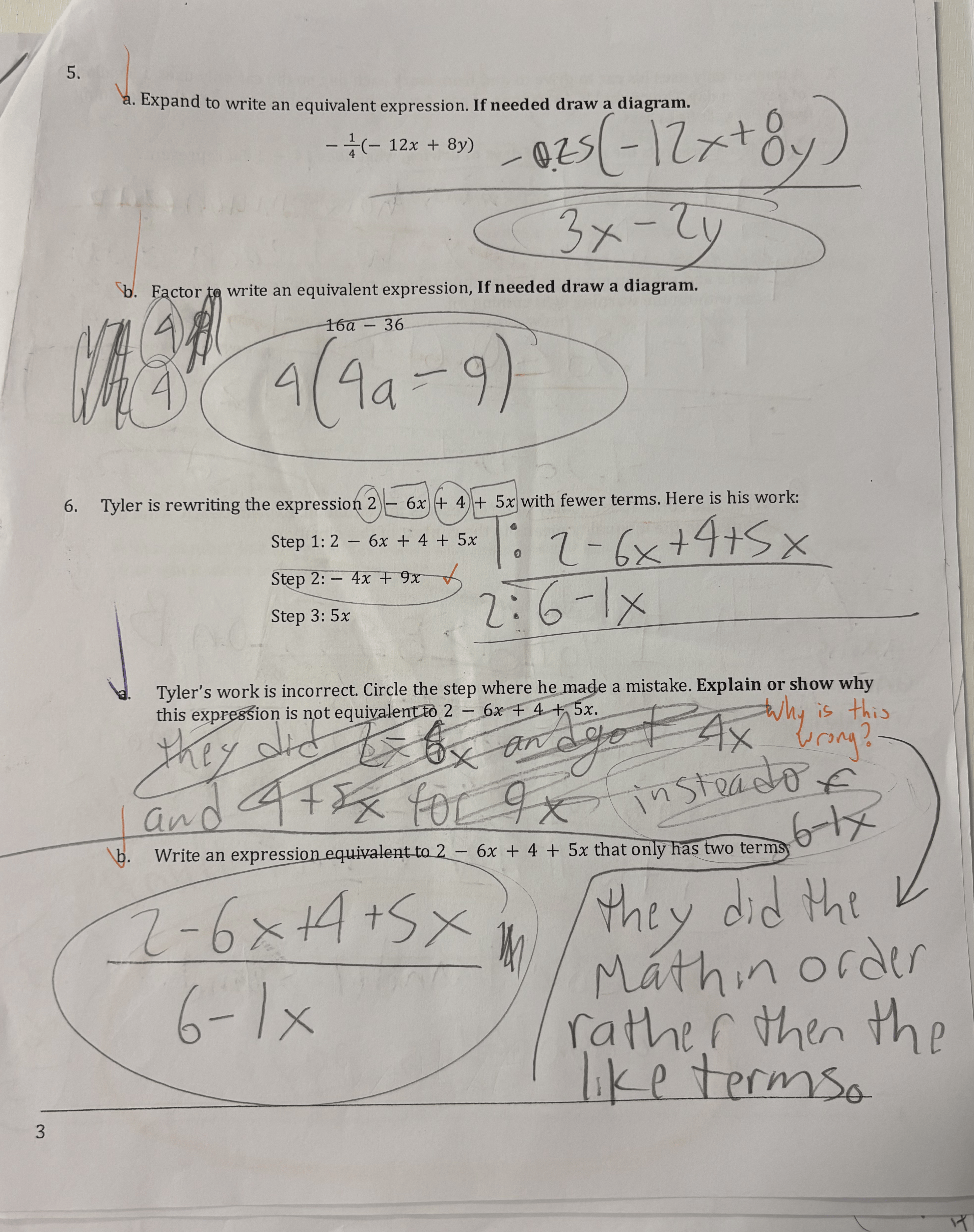
In this example, rather than simply marking the answer as incorrect, I prompted the student to explain why the step they identified was wrong. The student had correctly located the error in the sample work but had not yet articulated what went wrong mathematically. My feedback encouraged them to go further and in their revision, the student was able to explain the mistake using vocabulary from the unit, specifically identifying that like terms had been combined incorrectly. This exchange illustrated the value of feedback that pushes students to reason rather than just correct.
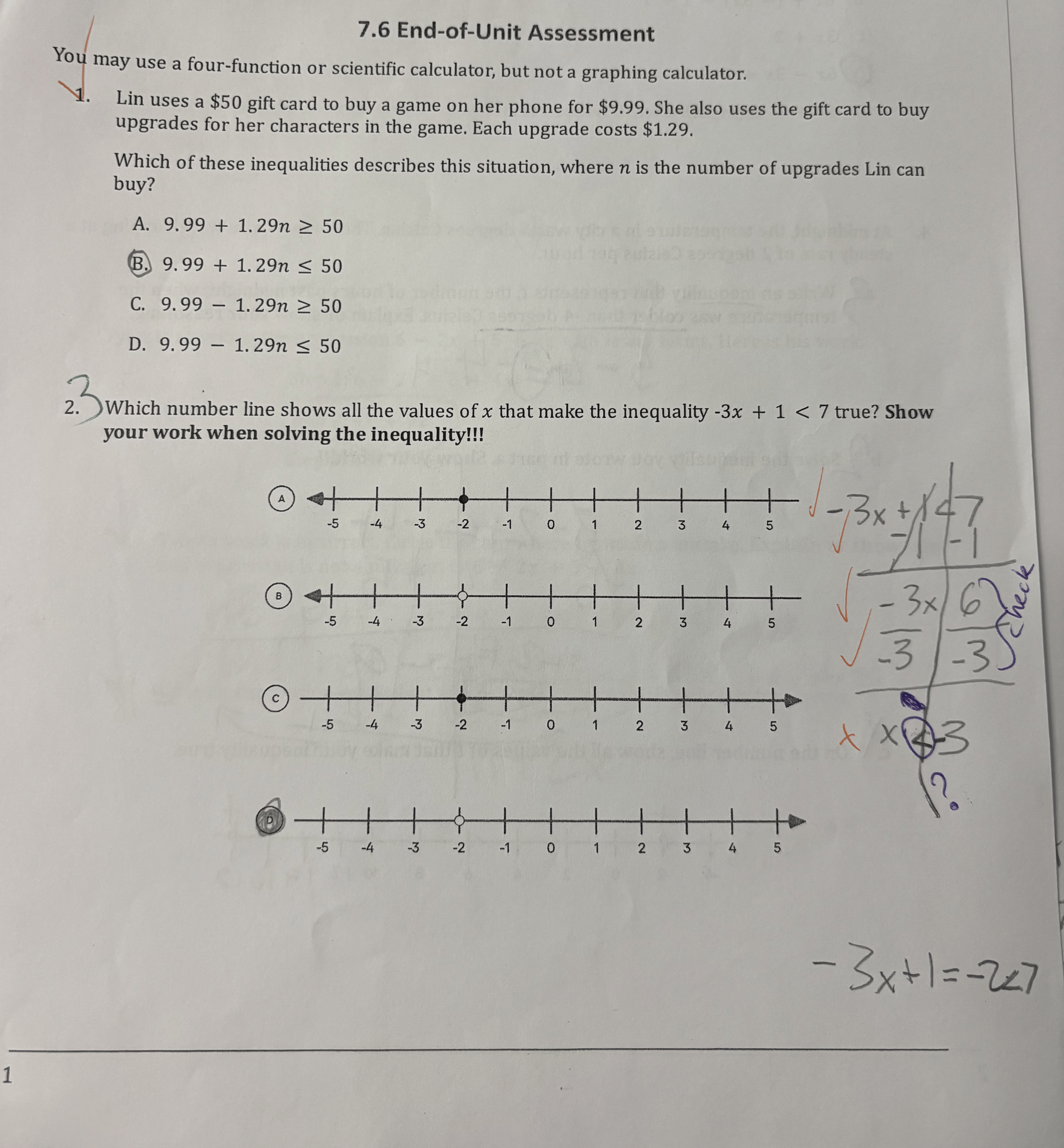
In this example, I acknowledged the steps the student had completed correctly before directing their attention to two specific issues. One issue was an arithmetic error in their work and the other was a missing inequality symbol in their final answer. Even if the arithmetic had been correct, the absence of the inequality symbol would have made the answer incomplete. While the student did respond to the feedback by adding an inequality symbol in their revision, they chose the wrong symbol and did not revisit the arithmetic error. This was a useful reminder that written feedback does not always lead to full correction. Students sometimes engage with only part of the feedback given, which points to the importance of also building in time to discuss common errors whole-class rather than relying solely on individual written comments.
Personal Lesson Reflections
Reflective practice is one of the most important habits a teacher can develop. Throughout my student teaching placement, I kept a running log of observations, challenges, and adjustments across my lessons. The following entries highlight key moments of growth across five areas of my developing practice: adjusting lesson difficulty, cold calling strategies, in-the-moment differentiation, classroom management, and pivoting when a lesson wasn't working.
What Happened
Early in my placement, I struggled with calibrating the difficulty level of the practice problems I wrote. After my mentor teacher was absent on 2/2, I reflected that the problems I had written for the 8th graders were too hard. Students were frustrated and the lesson lost momentum. This pattern repeated on 2/3, where I noted again that the challenge problems I wrote were too difficult for where students were, especially without enough scaffolding and support.
My Reflection
I realized I was writing problems at a level I found interesting rather than at a level appropriate for where students were in their understanding. Writing good practice problems requires knowing not just the content but the specific entry points and common struggle points of your students. This takes time and observation to develop, as well as a deep understanding of the curriculum. I also recognized that problems that are too hard can be more damaging than problems that are too easy, because frustration shuts down engagement entirely.
What I Did Differently
By 3/3 I noted that I felt good about the difficulty level of the practice problems I had put together, referencing other notes on the same subject to calibrate appropriately and then taking difficulty up only one step at a time. I also became more intentional about building in easier entry problems at the start of a practice set so students could build confidence before reaching harder material. By 3/18 I was able to reflect that I had done better with appropriate difficulty level, noting that I still included a couple of harder problems but in a more balanced way.
What Happened
On 2/13 I reflected on a challenge I was having with cold calling. Specifically, what to do when a student gets an answer wrong. I was worried about students feeling embarrassed or shut down in front of their peers, which was making me hesitant to use cold calling effectively as a discussion tool.
My Reflection
I recognized that the discomfort I felt was getting in the way of using cold calling as the powerful formative tool it can be. The issue wasn't cold calling itself, but rather that I hadn't established clear language and norms around mistakes being a normal and valued part of the learning process. Without that foundation, students had no framework for how to respond when they didn't know the answer.
What I Did Differently
I developed specific language to use when students struggled during cold calling:
- "Part of math is being able to express your ideas and thinking."
- "If you don't know the answer that is fine, but then I need you to explain where you are stuck or what you are confused by."
- "You are not the only one who is confused and we can all learn from each other's questions."
This reframe shifted cold calling from a performance moment to a thinking moment, reducing the stakes for students who didn't have the right answer while still holding them accountable for engaging with the content.
What Happened
On 2/20 I attempted an in-the-moment differentiation strategy during 8th grade scientific notation practice. After a diagnostic warm-up, the plan was for students who did well to choose an independent activity while students who struggled would move into groups to work together on the specific skill they needed. In practice, students ended up staying where they were rather than moving into the intended groups.
My Reflection
The differentiation intent was sound but the logistics weren't tight enough. Moving students mid-class into new groups based on diagnostic results requires clear procedures and student buy-in that I hadn't fully established. The students still ended up working on the skill they needed, with the differentiation happened in content even if not in grouping. Even without this grouping, I thought the lesson was effective and my mentor teacher agreed, saying that she noticed good student engagement. I also reflected on a similar activity for 7th graders that same day, a progressive three-level practice set, which I liked conceptually but found challenging to manage because many students came up to have their work checked at the same time. I discussed this with another teacher who had used a similar format, and she noted that she finds it easier when she makes the problems very quick to check and also added that she likes to include a few levels of easy problems at the start of the set to help build student confidence before they reach more difficult material.
What I Did Differently
These experiences informed how I implemented lessons like this moving forward. I have used a similar structure of students choosing their practice activity since then, but decided not to have students physically move into new groups mid-lesson. Instead, I have kept students in their original seats and had them choose from different activities at their desks, which has been easier to manage while still allowing for differentiation. I would still like to utilize grouping, but I would prefer to do so when I have my own classroom where I will be establishing my own norms and routines in. When doing this activity, I am intentional about the language I use, asking students what they feel they need to work on, to establish student agency over their learning. I also became more intentional about including easier problems at the start of practice sets to build confidence, and about making problems quick to check when I wanted to use a progressive difficulty format.
What Happened
On 3/5 I planned a scavenger hunt activity for 8th graders working on ordering and comparing irrational numbers. The activity was too complicated, students were disengaged, and almost no one was doing anything. I attempted to pivot to practice problems but the students were not receptive. I reflected honestly that I had overcomplicated the content too soon, asking students to order three numbers rather than starting with comparing two, and that estimating square roots, a skill the activity depended on, was something students found unengaging and difficult.
My Reflection
This was one of the harder days of my placement, and one of the most instructive. I recognized that the failure wasn't just about the activity format, it was about sequencing. I had moved students to a more complex task before they had enough fluency with the foundational skill. I also reflected that my own lack of enthusiasm for estimating square roots may have contributed to how I framed and delivered the content, which is a reminder that teacher energy is contagious in both directions.
What I Did Differently
In subsequent lessons, I became more deliberate about sequencing complexity, introducing one new element at a time rather than combining multiple challenging skills in a single activity. I also became more attentive to the difference between an activity that isn't working because of student engagement and one that isn't working because of task design, since the response to each is different. On 3/17 I reflected that switching from marker work to packet work helped students be calmer and more productive, which was a small but meaningful pivot that reinforced for me that variety in format matters as much as variety in content.
Responding to Feedback
Receiving and responding to feedback is one of the most important parts of growing as a teacher. Throughout my student teaching placement I received regular feedback from my mentor teacher, university supervisor, and school administration. The following entries document specific feedback I received and the steps I took to address it. I approach each piece of feedback as an opportunity to refine my practice and become a more intentional and responsive educator.
Feedback Received
After my first formal observation on 2/3, my mentor teacher noted that I should use simpler and more straightforward examples when introducing new content, and that I should slow down my pace to give students more processing time. At that point in my placement I was moving through content at a pace that felt natural to me but was too fast for students who were encountering the material for the first time.
How I Responded
I became more deliberate about starting with the most basic version of a concept before increasing complexity, and about building in pauses and countdowns to give students time to think before expecting responses. This connected directly to the improvements I was making in calibrating the difficulty of my practice problems. Both changes reflected a broader shift toward meeting students where they were rather than where I expected them to be.
Feedback Received
After my second formal observation on 2/11, my university supervisor encouraged me to put more of the cognitive load on students rather than explaining everything from the front of the room, specifically suggesting I ask students whether they are ready rather than managing their attention directly. My mentor teacher echoed this, encouraging me to use more positive praise and proximity to manage behavior and to use cold calling more effectively to keep students engaged and accountable.
How I Responded
I began incorporating cold calling more consistently and adopted language that placed responsibility on students — phrases like "are you ready?" and "do I need to wait for you?" shifted the dynamic so students were signaling their own readiness rather than me managing it for them. I also became more deliberate about using positive praise for on-task students as a proactive management strategy rather than only responding to disruptive behavior. By 3/19 my mentor teacher noted that I was doing well at cold calling and keeping students more engaged.
Feedback Received
My mentor teacher pointed out that doing the same activity format multiple days in a row caused students to disengage quickly, and encouraged me to vary formats more intentionally. This was reinforced in a conversation with another teacher on 3/20, who noted that even activities students initially enjoy lose their effectiveness when used too often.
How I Responded
I became more intentional about rotating formats across consecutive lessons, alternating between marker work, packet practice, whiteboards, five-minute drills, and online activities. On 3/17 I reflected that simply switching from marker work to packet work made students noticeably calmer and more productive. This feedback also influenced how I thought about planning, pushing me to consider the sequence of activities across a unit rather than just within a single lesson.
Feedback Received
During a classroom visit on 3/20 the school principal noted that he liked seeing learning targets and success criteria included directly on student materials. This was feedback I had not received before and it prompted me to reflect on how consistently I was making the purpose of each lesson transparent to students.
How I Responded
Following this feedback I made a deliberate effort to incorporate learning targets and success criteria into the materials I designed, so students could clearly see what they were working toward and what success looked like. This connected to broader conversations I had been having with my mentor teacher about helping students understand the why behind their learning. Making success criteria visible is one concrete way to answer that question before students even have to ask it.