Caitlyn Rawlings

General Parent Updates

The following unit messages were drafted by me and sent to families by my mentor teacher through ParentSquare, our school's family communication platform. These messages kept families informed of upcoming units, learning objectives, and ways to support their student at home.

Final ParentSquare Message Content · March 2026

Upcoming Math Units: Scale Copies and Circle Measurements (7th Grade)


Unit: Scale Copies

In this one-week unit, students will explore how scaling shapes by different factors affects measurements like side length and area. This is a great opportunity to review proportionality, a concept we covered earlier in the school year.

Note: There will be no unit test on scale copies.


Unit: Circle Measurements

Following scale copies, we'll spend one week on circle measurements, including radius, diameter, circumference, and area. This unit includes a summative assessment.

Testing Date: Week of March 23rd


Khan Academy offers excellent practice problems for both units. If your student would like additional opportunities to strengthen their skills, these free resources are a wonderful option.


If you have any questions about expectations or support at home, feel free to reach out. Thank you for your continued support!
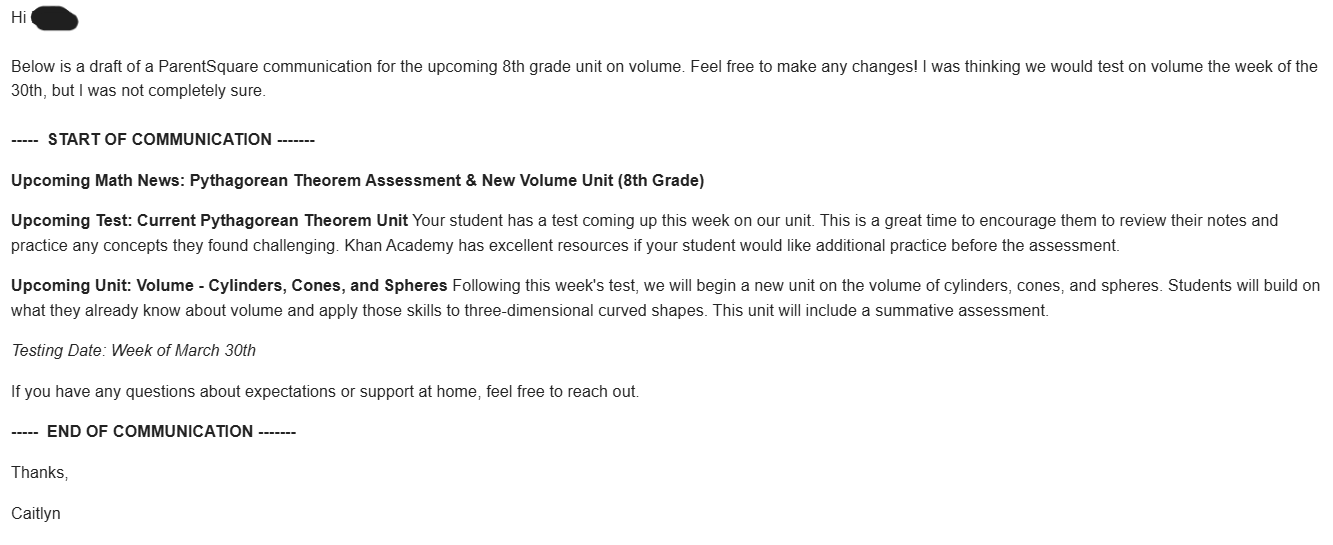
Draft of Parent Communication Emailed to Mentor Teacher · March 2026
Draft of email sent to mentor teacher for review

Parent Communication About Student Behavior

The following emails were drafted by me and sent by my mentor teacher to the families of students in my classes. These communications reflect my commitment to maintaining open, professional, and timely communication with families regarding student behavior. This particular class had become increasingly challenging to manage, so I made the decision to proactively reach out to families to address disruptive behaviors and enlist their support. I also made a point to send positive emails home to students in this class who were making good choices, reinforcing those behaviors and expressing appreciation for students who were serving as positive role models for their peers.

Positive Behavior Emails

Body of Email to Student Parent · March 2026
I hope you are doing well. I wanted to reach out to let you know how much I have appreciated [Student's Name] in 6th period math class.

Over the past few weeks, this class has become increasingly difficult to manage, with many students being disruptive and making it hard to teach. [Student's Name], however, has been a student I can consistently count on to not contribute to the distracting environment. That kind of behavior does not go unnoticed, and it makes a real positive difference in the class.

I appreciate your support at home, as it clearly shows in the classroom.

Please don't hesitate to reach out with any questions.

Behavior Concern Emails

Body of Email to Student Parent · March 2026
I hope you are doing well. I wanted to reach out regarding [Student's Name]'s behavior in 6th period math.

Over the past few weeks, our class has become increasingly unruly, with many students talking or yelling over me and making it difficult to teach. Unfortunately, [Student's Name] has been contributing to this environment. Despite repeated reminders, the behavior has continued.

I was hoping you could have a conversation with [Student's Name] about this. I appreciate your support in helping keep our classroom a positive and productive place.

Please don't hesitate to reach out with any questions.

Department & Staff Meetings

I attended all staff and PLC meetings held during my student teaching placement. The following are selected examples that represent the range of topics and discussions I observed and engaged in. As a student teacher, I started primarily in an observational role, but as my placement progressed, I was able to contribute more actively to discussions and planning. These meetings significantly shaped my understanding of how collaborative professional communities use data and shared planning to support student learning.

PLC Meetings

PLC Meeting · February 13, 2026
Agenda:
  • Decide which common formative assessment to bring to 2/17 enrichment day
  • Figure out how many IM workbooks we need to order for next year
  • Data analysis
Minutes:

Attendance

Sign-in sheet collected at meeting.


Common Formative Assessment — Enrichment Day 2/17

  • 6th Grade: 6.6 Checkpoint A
  • 8th Grade: Scientific Notation Cool Down

IM Workbooks for Next Year

  • No workbooks: Mentor Teacher, J.
  • Yes workbooks: J.
  • Maybe workbooks: E., P.

Spiral Review Documents

  • 8th Grade spiral review doc — shared with team
  • 7th Grade spiral review doc — shared with team
  • 6th Grade spiral review doc — shared with team

Data Review

6th Grade

  • This week: 6.6 Checkpoint A

7th Grade

  • This week: 7.5 Mid-Unit Assessment

8th Grade

  • This week: N/A
My Contributions and ReflectionsThis was near the beginning of my placement, so I was primarily in an observational role during this meeting. I observed as the team discussed which common formative assessments to bring to the upcoming enrichment day, which is an all-day professional development day for teachers. This was informative to observe as it showed me how the team uses common formative assessments as a tool for professional development and collaborative learning, as well as how they determined which assessments would be most useful for the team to review together during the enrichment day. I also observed as the team discussed whether or not to order workbooks for next year, which was interesting to see how the team weighs the pros and cons of different resources and makes decisions together. Certain factors were important to the teachers, like the grade-level teams being on the same page with what resources to use. The data review portion of the meeting was particularly useful to observe, as it showed me how the team analyzes student data together, identifies areas of struggle, and uses that information to inform their instruction moving forward.
PLC Meeting · March 13, 2026
Agenda:
  • Plan next week's Falcon Times
  • Plan for and schedule upcoming team observations
  • Check out the End-of-Unit survey [Mentor Teacher] made
  • Create exemplars for upcoming units (if time)
  • Data analysis
Minutes:

Attendance

Sign-in sheet collected at meeting.


Falcon Times Planning

  • P. — Test
  • E. — Test
  • J. — Test
  • Mentor Teacher — Circle
  • J. — Test

Upcoming Team Observations

The team was asked to select a Standard of Mathematical Practice related to student talk and discourse. Focus standard: CCSS.Math.Practice.MP3 — Construct viable arguments and critique the reasoning of others.

Teacher Look-Fors:

  • Wait time and silent think time
  • Sentence starters
  • Acknowledging all points of view
  • Asking open-ended and DOK questions
  • Finding ways to engage all students

Student Look-Fors:

  • Constructing viable arguments
  • Critiquing each other's reasoning respectfully
  • Quality responses beyond simply disagreeing
  • Comfort making mistakes and sharing reasoning
  • Engagement

End-of-Unit Survey

Team reviewed and discussed the end-of-unit survey.


Assessment & Curriculum Discussion

  • Discussed adjusting tests to group standards together
  • Team to create exemplars for upcoming units across 6th, 7th, and 8th grade

Data Review

6th Grade

  • This week: Cool Down 6.6.14

7th Grade

  • This week: 7.6 End-of-Unit Assessment

8th Grade

  • This week: Lesson 3 Cooldown (square roots)
My Contributions and ReflectionsI helped contribute by assigning kids to my Mentor Teacher's classes for the next Falcon Time, where they would be doing 7th grade practice of circle measurement problems. I also assigned students from my classes who needed to do test corrections or retakes to another teacher's class for the next Falcon Time. I observed as the team worked on planning for upcoming team observations, in which the teachers from the team would be observing each other's classes and providing feedback on the use of student discussion in class. I also observed as the team worked on finalizing the End-of-Unit survey that my Mentor Teacher had created, which would be given to students at the end of each unit to gather feedback on what they found most helpful and what they still had questions about. I found this useful to observe the types of information the team values gathering from students, and I think that this is a powerful tool I could use in my own practice. We did not have time to work on creating exemplars for upcoming units. The 8th grade teachers needed to finalize the upcoming Pythagorean Theorem unit test. I contributed to this, sharing my thoughts on the types of problems that would be appropriate on the test to measure the learning objectives for the unit. We also spent some time sharing our analysis of formative data from exit tickets. I shared that while many students did well when solving for the hypotenuse, a common area of struggle was solving for a leg when given the hypotenuse and the other leg. I also shared my observations that the students from my classes had a hard time estimating the value of square roots, which is a skill that was going to be on the test, and I ensured that our unit review included some practice on that skill.

Staff Meetings

Staff Meeting · February 3, 2026
Agenda:
  • National School Counseling Week
  • Recognizing warning signs
  • Resources for students in crisis
  • Winter I-Ready test scores analysis
My ReflectionsThis staff meeting deepened my understanding of the whole-child approach to education, reminding me that student wellbeing directly impacts their ability to learn. The session on recognizing warning signs and crisis resources was particularly valuable, as it gave me concrete tools to identify and respond to students who may be struggling beyond the classroom. Reviewing the Winter I-Ready scores as a staff also reinforced the importance of using data collaboratively to understand where students are and how to best support their continued growth.
Staff Meeting · March 3, 2026
Agenda:
  • Formative assessment process
  • Incorporating Claim-Evidence-Reasoning
  • DOK levels and deep thinking
My ReflectionsThis staff meeting strengthened my understanding of how to design instruction that pushes students toward deeper thinking, particularly through the frameworks of Claim-Evidence-Reasoning and Depth of Knowledge levels. I found the reflection on what aspects of this process we are implementing well and where we can grow as a team to be particularly useful, as it gave me a clear sense of how the math team is currently using these frameworks and where there are opportunities for growth. I also appreciated the discussion of specific strategies for incorporating these frameworks into instruction, as it gave me concrete ideas to try out in my own practice.
Staff Meeting · March 19, 2026
Agenda:
  • Family communication
  • OMS Instructional Vision
  • High levels of learning - students understanding the why
My ReflectionsThis staff meeting prompted me to reflect on how I communicate the relevance of content to my students and help them understand the purpose behind what we are doing in class. Although I had already been working to incorporate this into my lessons, this discussion gave me a clearer framework for thinking about it more intentionally and consistently. The conversation reinforced that students who understand the why behind their learning are more likely to be engaged and invested. I want to be more deliberate about building into my lesson openings and closings going forward.

Professional Development

Professional Development Day · February 17, 2026

Facilitator

Core Collaborative National Coach


Focus

Deepening the Formative Assessment Process


Agenda

  • Deepening understanding of the formative assessment process
  • Clarifying the purpose and differences between formative and summative assessment
  • Understanding the shift in cognitive demand from elementary to middle school
  • Strengthening Claim–Evidence–Reasoning (CER) instructional strategies

End-of-Day Product

Teams developed a formative assessment incorporating higher DOK levels, aligned success criteria, and a self and peer assessment plan.

My ReflectionsThis professional development day was one of the most directly applicable learning experiences of my student teaching placement. Working alongside the full teaching staff deepened my understanding of how formative assessment, when done intentionally, shifts the classroom dynamic from teacher-driven evaluation to student-owned learning. The focus on Claim-Evidence-Reasoning as an instructional strategy was particularly valuable for me as a math teacher, as it pushed me to think beyond procedural fluency and consider how I can structure tasks that require students to justify their thinking and engage in genuine mathematical reasoning. The discussion of Depth of Knowledge levels also gave me a practical framework for evaluating whether my own questions and assessments are pushing students toward deeper thinking or keeping them at surface-level recall. By the end of the day, I had revised an existing formative assessment to incorporate higher DOK levels and clearer success criteria, which I was able to bring directly back into my classroom. This experience reinforced my belief that professional development is most powerful when it is immediately actionable, and I left with concrete strategies I am still actively applying in my teaching practice.

IEP & Student Support Meetings

Participating in student support meetings is a critical part of professional practice that extends well beyond the classroom. During my student teaching placement, I had the opportunity to attend an IEP eligibility meeting, which gave me firsthand experience with the collaborative process schools use to identify and support students with diverse learning needs. In accordance with student privacy requirements, no identifying information is included below.

IEP Eligibility Meeting · March 11, 2026

Meeting Details

Attendees: School counselor, student's mother, classroom teachers, principal

Purpose: To discuss the possibility of evaluating a student for an IEP or 504 plan


Discussion

  • Teachers shared observations of the student's academic strengths and areas of difficulty.
  • Team discussed whether the student's disability was negatively impacting their academic performance.
  • Collaborative discussion between teachers and the student's mother led to the decision to proceed with a formal IEP evaluation.
My ReflectionsAlthough my role in this meeting was primarily observational, it was an incredibly valuable experience that deepened my understanding of the collaborative and student-centered nature of special education support. I observed how the team came together to discuss the student's needs, with each member contributing their perspective and expertise. The discussion was focused on what would best support the student's learning and wellbeing, which reinforced for me that effective teaching requires a holistic understanding of each student and a commitment to working collaboratively with families and colleagues to meet their needs. Because I was familiar with the student's classroom behavior and academic performance from my own teaching experience, I was able to reflect on how the information shared in the meeting aligned with my own observations. This experience made me more aware of the importance of being an active participant in these processes as a future educator, advocating for my students and collaborating with families and support staff to ensure all students have access to the resources they need to succeed.